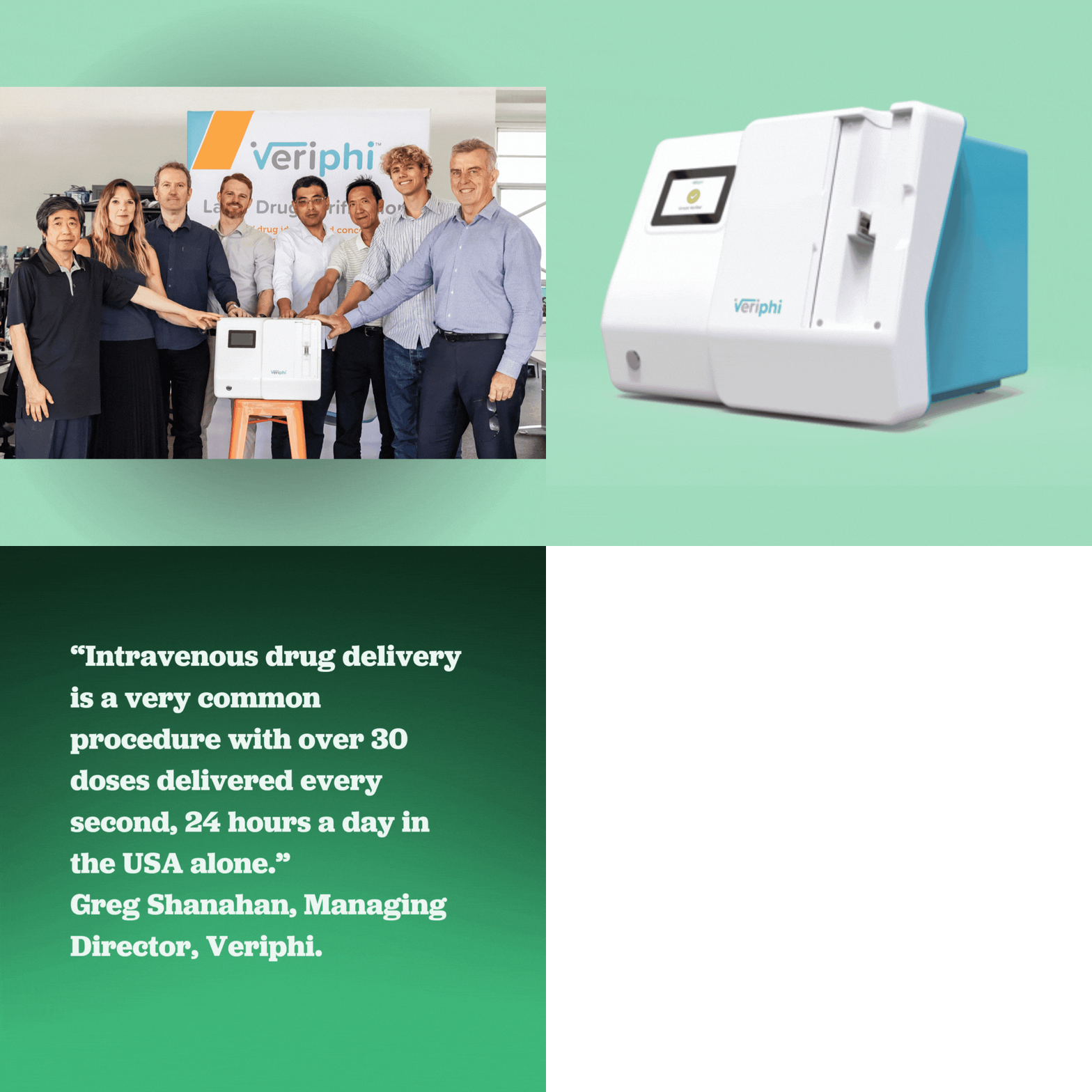

Greg Shanahan (Veriphi)
In this episode of the Funding Files we interview Greg Shanahan, founder of Veriphi, about Veriphi’s innovative solution to prevent medication errors using laser technology, AI, and cloud computing, and his big goal to create a billion-dollar company here in Aotearoa New Zealand.
In the pod we cover Veriphi’s development, funding journey, and future plans with the goal to reduce the 3% of hospital patients harmed by preventable medication errors, particularly with high-impact cancer drugs. Greg shares his background, including his work at Fisher and Paykel, which inspired the idea to apply a recurring revenue model to intravenous drug administration, noting that 30 drugs are administered every second in the US.
The conversation focuses on Veriphi’s funding history, starting with personal funds and early investors like Roger Lampen, who Greg cold-called when he saw him investing in other health tech companies.
Greg shares insights on capital raising, emphasizing persistence and focus. He advises founders to manage stress and focus on the steps they think will make them succeed. Ultimately, Greg highlights the importance of building a team where everyone feels ownership and contributes to the company’s success.
Highlights
Veriphi’s Innovative Solution and Its Impact
- Greg Shanahan, founder of Veriphi, is introduced as having worked on Veriphi for 15 years, developing a solution to prevent patient harm by reducing intravenous medication error and optimizing patient outcomes.
- Veriphi utilizes spectrometry, cloud computing, AI, and machine learning.
- The tech uses lasers to scan the spectrum of intravenous drugs to recognize specific drug signatures, focusing on the effect of the drug on light passing through it.
- It can also identify cancer drugs at specific concentrations, addressing the risk of medication errors, which harm about 3% of hospital patients.
- IV medication errors are particularly risky because of the rapid circulation of drugs in the body (around 23 seconds), limiting the chance to correct mistakes.
- Cancer drugs pose the highest risk due to their high impact on very sick patients.
The Genesis of Veriphi and the Healthcare Model
- Greg shares that his experience working for Fisher and Paykel appliances and alongside Fisher and Paykel Healthcare inspired the idea for Veriphi.
- He saw an opportunity to build a recurring revenue business around a common intervention, similar to the healthcare model for respiratory humidification or obstructive sleep apnea, applied to intravenous drug administration.
- The value Veriphi provides includes making patients safer, improving outcomes with more efficacious doses, and saving hospitals costs in drug preparation and delivery.
Funding the Start of Veriphi
- Greg Shanahan initially funded Veriphi personally, then reached out to acquaintances with available capital, and later to individuals with more substantial funds.
- Approximately $15 million has been spent on development, primarily from private individuals.
Securing the First Significant Investor
- Greg Shanahan recounts how he secured Roger Lampin, the company’s chairman and largest financial investor, by identifying him as a shareholder of other health tech companies and discovering he lived nearby.
- Roger Lampin answered the phone, visited the office that afternoon, and offered to invest three times the amount initially requested.
Challenges in Raising Equity and Investor Perceptions
- Greg Shanahan notes the significant difference between raising equity at the concept stage versus when close to revenue generation.
- Health tech and deep tech face challenges because investors often don’t understand the technical risks.
Persistence and Competitive Advantage
- Greg emphasizes the importance of persistence and determination for success.
- He compares Veriphi’s journey to that of Fisher & Paykel Healthcare, which was incubated for 20 to 30 years by Fisher & Paykel appliances.
- Persistence provides a competitive advantage that corporations, focused on quarterly reports, cannot match.
Growth Potential and Financial Projections
- Greg Shanahan highlights the exciting growth potential from an accountant’s perspective, including the opportunity to sell or lease analyzers to every hospital.
- Revenue per analyzer will grow as the drug library expands.
- Revenue will further increase as the analyzer is adopted throughout the hospital.
Competitive Advantages and Market Disruption
- Veriphi has eight granted US patents and 22 granted globally, along with significant know-how, IP, and trade secrets, making it difficult for competitors to replicate.
- The company continues to push boundaries by lowering concentrations and increasing analyzer sensitivity.
- Greg Shanahan aims to displace major incumbents in the market, drawing inspiration from successful New Zealand industries like film and spaces
Lessons Learned in Capital Raising
- Greg Shanahan wishes he had known more about capital raising before starting, particularly regarding the unpredictable funding needs of deep tech.
- He compares it to jumping out of an aircraft and reading a book on parachute design with limited time.
- Raising too much money at the start could lead to wasteful spending.
- Equity crowdfunding was the right choice for Veriphi, keeping the investor base informed and allowing the company to fund what was needed.
Tips for Founders and the Value of People
- Persistence is everything; it trumps intelligence and cleverness.
- Founders must show up for work and support their team, focusing on the task at hand.
- Confidence and relaxation are essential for success.
- Attracting smart, motivated people is a highlight, as is contributing to their livelihoods.
- Providing for others is inherently healthy.
🎧 Listen to the Full Episode
👉 Ep6 – The Funding Files on Apple: https://podcasts.apple.com/us/podcast/ep-6-greg-shanahan-veriphi-on-raising-privately-publicly/id1807671123?i=1000713329916
👉 Ep6 – The Funding Files on Spotify: https://open.spotify.com/episode/0bKUvmfiftDc1pzNwTUwgM
Read the full transcription of the Podcast here ↓
Kia ora and welcome everyone to another episode of the Funding Files where we explore the highs, the lows, and the cash flows of funding a business here in Aotearoa, New Zealand. I’m your cohost, Anna Gunther, also also cofounder and chief bubble door of PledgeMe. PledgeMe is a New Zealand based crowdfunding platform, and we’ve supported over 700 successful reward and equity based crowdfunding campaigns with over $75,000,000 pledged through the platform. We’re all about helping Kiwis fund the things they care about. My cohost is Matt Stevens, fractional CFO here at PledgeMe, but also cofounder and director of my favorite beer, ParrotDog.
He’s a chartered accountant and chartered member of the Institute of Directors and experienced in capital raising for himself and helping others. If I were a book, Matt would be a calculator. Hi, Matt. How’s it going? Good.
Good, Anna. Great. Excited to be here today. We’ve got the first mid tech company to talk to, so that’s really exciting. Hey.
And we’re gonna roll straight into it. In this episode, we’re chatting to Greg Shanahan, one of the longest running founders we’ve interviewed who’s been tirelessly working on Verify for the last fifteen years. Verify has developed a radically innovative solution to prevent patient harm by reducing intravenous medication error, but at the same time optimizing patient outcomes through more accurate dosing, especially with high impact medication like cancer drugs. So this is very deep tech and utilizes things like spectrometry, cloud computing, AI, and machine learning, and we’re really lucky to have Greg here chatting to us today. Hi, Greg.
How’s it going? Good. Thanks, Hannah. How are you? Good.
Can we roll straight in, Greg? Do you wanna just introduce yourself? Tell us a bit about you. So my name’s, Greg Shanahan. I’m born and brought up in the Hutt Valley in, Wellington.
This is my kind of third gig in in life. I’ve had two other jobs before that and decided that it was probably best of I work for myself. So I’m a founder of two businesses. One is Verify, and the other is an another business called Technology Investment Network, which curates the community for globally focused tech businesses through, data. So in terms of Verify, we’re looking to walk the talk in terms of my personal goal is to build a big iconic Kiwi business that hopefully will last longer than me.
Great goal. And with that big iconic business, do you wanna tell us more about what Verify does? I shared at a high level, but what does Verify do? Yeah. So, Verify has developed a radically innovative solution, essentially uses lasers to scan the spectrum of intravenous drugs to recognize specific drug signatures.
So we’re looking at the effect that a drug would have on light passing through it, which is characteristic of the molecular composition of the drug. So we pass laser beam through the drug and recognize, drugs, in this case, cancer drugs, at specific concentrations. So that’s a very difficult thing to do. It sounds so simple that surely someone would have done this already, but there’s a lot of reasons why it wouldn’t work. And so it’s very much deep tech, uses, laser science, uses artificial intelligence and and cloud computing to recognize each drug at a specific concentration.
And the reason we do that is that medication error is a common risk for hospital patients, particularly intravenous medication errors. So about three percent of hospital patients are harm to preventable medication error, and IV medication is at the high end of that risk because a drug, once administered, the patient circulates the body around about twenty three seconds. So your chance of, mitigating once you made a mistake, is pretty limited. And at the most dangerous end are cancer drugs because you’re administering high impact drugs to very sick patients. So you’ve got someone trying to walk a knife edge in terms of when they potentially live or die, and and the impact of giving them a wrong drug can be catastrophic.
So we think that’s a a good thing to do and motivates us. So how did you get to that that in the first place? Was it a problem you’re trying to solve, or did you figure out that there was a that there was a solution here for, you know, a a problem we want? I guess my own path to this was that my only other job in, New Zealand prior to this was working for Fisher and Paykel appliances and went to The States to set up the business there and worked alongside Fisher and Paykel Healthcare. And the notion of, firstly, being involved in the health space is, obviously, it’s a life positive thing to do.
But, secondly, the opportunity to build recurring revenue as a business around a common intervention seemed like a a big opportunity. So if you took the health care model for respiratory humidification or obstructive sleep apnea, and you applied that to a far more common procedure, which is administering drugs intravenously, seem like a logical thing to do. So in The US, about 30 drugs are administered every second. So you’re almost in fintech territory here, just massive volume. And if you can add value to that, I guess, transaction, if it was a fintech product, then that’s a big business.
So the value that we provide are making the patient safer, improving outcomes in terms of giving a drug at a more efficacious dose that won’t harm the patient, I mean, saving the hospital significant amount of cost in terms of drug preparation and delivery. And I guess the question that is on everyone’s mind is, like, isn’t this already happening? Like, isn’t there a way for people in hospitals to make sure that they’re providing the right drug at the right dose? You you would think so. So the means of doing it at the moment is is trying to regulate processes so that if you do everything in the right procedure, if you have a cookbook that somehow you get to the the right cake.
But when you’re doing that repeatedly, often like typing a document, there’s always the opportunity for human error to intervene. The problem is that the hospital or the clinician doesn’t necessarily recognize when that error occurs. So studies have shown that one percent of medication errors are reported when there is no system to record them, about fifteen percent when there is a system. So even when there are systems involved, about eighty five percent of medication errors are never reported. In the case of cancer patients or people who are elderly, if they’re on a decline, the fact that they might die or respond in an an unusual way is not surprising.
So it’s clouded in the the outcomes for patients. And I feel like the medical profession is just is just so conducive to human error when they’re working huge hours through the night and they’re just, you know, back to back shifts and that. So it seems like you need some tech to to be a cross check there. Right? Oh, absolutely.
So in the pharmacy where we’re starting out, as the the hospital’s got producing drugs for the people who have already been admitted to hospital. But then day patients come in and and the amount required urgently balloons. And so with family members that my daughter’s a doctor working in the health care system. It’s just it’s hard to understand how they actually function, particularly when, you know, immediate course of judgment are required or you’re trying to do something that the difference can be the difference between life and death. So you’ve got this problem statement.
You know? You’ve got a a huge amount of potential harm to humans. You’ve got a concept to solve it. What what came first, and how did you get a prototype? So how the business started is I was approached by an inventor who had this idea of using spectroscopy originally for blood.
That proved, an interesting concept, but hard to do, so we focused on on drugs. And, essentially, with people who had expertise in in in those technical skills, we developed some working models until, you know, we we we were able to, tell that the using spectrum and particularly in the near infrared part of the spectrum where we look we had quite a lot of opportunity to be able to do this. Why it takes so long is there’s so many things in the way, so many variables that have to be controlled to get the level of resolution that you require to see drugs. I mean, we’re looking at drugs now down to about point one milligram per mil. So we’re looking at hugely sensitive areas and something that’s gonna be a common everyday process.
So you’ve got to ruggedize your your measurements to account for any variabilities that might exist in the in the delivery ecosystem. And if someone wanted to test a drug right now, how how long would that take, and how long does your process probably, they’d send it off to an HPLC laboratory. So it’d take sort of twenty four to forty eight hours, and it’d be very expensive. So, ultimately, we’ll be doing that in seconds. At the moment, it’s about two minutes.
So you don’t have to send the sample off to the to the laboratory. So the difference between what’s happening now and what our goal is, for this to be a simple process that can be done in seconds that’s not disruptive to clinical practice. So the two things are it’s it’s gotta work. Well, three things, really. It’s gotta work, it can’t cost too much, and it can’t be disruptive in a in a an environment that’s very, time poor.
And when you first started this, how did you fund the Start to Verify? So I funded it, personally, then reached out to people we knew that seemed to have some might have some spare cash. And then as we went forward, reached out to people I didn’t know who who had more cash than the than the people I was friends with to fund it. And so we’ve spent about, $15,000,000 in the course of developing this, and most of it’s from private individuals. So that’s been people who have shoulder tapped or through equity crowdfunding like this.
So our next step after this raise will be to large institutional funders that can provide sort of upwards of about, certainly, over 5,000,000 up to about potentially 10,000,000 to support us. And do you wanna talk us us through that first external raise that you did when you started shoulder tapping friends? Like, how did you do that? Like, what was the process you took to go out? I probably really badly, I would say.
And in effect, I think one of the things as a founder, you just got you gotta get used to doing things badly and be comfortable with that and, obviously, learn and try and do better. So, hopefully, the pro selling the proposition will be a lot more focused than when I started. Our first significant investor, was our chairman, Roger Lampen, who’s the largest financial investor in the company. I was we were getting short of money, and so I was thinking who I knew. And I knew that Roger I was looking around, essentially, and I so I was looking at shareholders of other health tech companies.
And I found Roger’s name in the company’s office, and then I realized he lived in in Davenport where we are based. And so if I phoned him up, he answered the phone, said, he was coming down that afternoon. So I was pretty excited by this stage because, you know, 9% of people don’t return their calls And came that afternoon, and it sort of seemed to go well. I did this sort of presentation presenting from my desk. I think there were three in the office.
And then he phoned it up, I think, that night or the next day and said he wanted to invest, but he wanted to invest three times as much as I’d asked for. Fantastic. Well, of course, as you can understand, it’s highly reluctant to have more money. So and then a couple of days later, he come in and said, well, we’re kinda done, aren’t we? I said, are we?
And, so I said, look. I’ve got all this due diligence stuff to give you, so you better take that as I probably should. And and that was it. So I I guess one of the lessons for early stage companies looking for money if you’re dealing with people who’ve been successful in business, they’re gonna make a pretty quick assessment about whether or not it’s up to speed. So one of the things that I did was part of that.
I give gave him a referee who was the captain of industry in New Zealand who I’d worked with who obviously must have said nice things. So Roger Roger was impressed. So that was the kind of first time I I stepped out of, away from people that I knew. And I we we we’ll get to where the business is currently, but is that obviously, the business is, you know, about to about to execute its first revenue opportunity, but that was all very much pre money pre revenue. And is it much different trying to raise equity when you’re it’s much more of a concept stage than than close to the revenue that is now?
Oh, hugely different. I remember going to see someone, a funder who’s made a lot of investment, and he said, look. Before you came here, Greg, I’ve wrote written on the back of a piece of paper how much New Zealand investors have lost in health tech and so far, up to about 400,000,000. And so they go, oh, it doesn’t sound like this meeting’s gonna go all that well. It it it didn’t.
And so the problem with health tech or deep tech is people think, well, I don’t understand the technical risk. Sure. It might be a big opportunity, but anyone can click a look at anything. If I don’t understand the risks, I’m not going to invest. So there’s a pretty small pool of people.
I think if I look at a Roger Lampens example, he said, this potentially will be such a good thing. It’s worth the risk. And so the second part is for them to understand they know you’re really focused, and you have some idea of what those risks are rather than blind optimism optimism without a clue about what’s involved. And so you’ve done a number of rounds, and and has there been sort of different stages you’ve had to fund, or has it all been sort of largely into the the the development and and the the research of it all? Primarily into the development.
So it’s more multilayered, and you just never know you know, you can predict something will happen, but you never know if the money that you’ve invested is going to solve the problems that you haven’t anticipated. Early in our journey, we went out to four of the largest health tech companies in the space in the world, And it was clear that three of them had tried to do it or tried to try to source technology that did it and not been successful. So their attitude is, well, if we couldn’t do it, I can’t see any reason why you would be able to do it. And so if they think that, then, you know, the people who know nothing about the market, are very brave. So we’re fortunate that as happens with serendipity, there clearly is a need because our our first customer approached us.
Saint Vincent’s are the largest not for profit health and aged care provider in Australia. We were pretty excited when they did that. So working closely with them, we were able to have been able to really focus on exactly what was required for their application, but I was kind of in communication on almost daily basis. So once you’ve got that dialogue going, you can move quite quickly. Plus, we got the team to a point we had the expertise on board that had the capability of solving those problems.
So we really broke it down at a granular level and knocked them off one by one. Yeah. Did that did those big tech saying that they couldn’t do it, did that make you did that deflate you in a way or just make your heart in your resolve and go, we’re gonna get this done? Oh, that’s a long cut. No.
You’ve just gotta decide very early on that you’re gonna be successful, and you’re not gonna stop till you do. So if you looked at, say, a company like Fisher and Paykel Healthcare, you know, they were incubated for twenty to thirty years by Fisher and Paykel appliances, and they just kept on going. And that’s where you get the advantage because no corporate generally would do that. You know, people report particularly public companies in quarters, so no one would want to report for fifteen years that this thing was still going, but they didn’t have any revenue. So if you persist that long, it’s a competitive persistence is a competitive advantage.
And there was a good outcome marketing sales for b Braun’s hospital business, which is a a $15,000,000,000 privately owned gym medtech company. And so he’s got enormous experience. So we’ve been very lucky, very lucky with the support that Fisher and Paykel Healthcare provides. So essentially anything we require on compliance or documentation or pretty much anything as the company evolves, they lend support too. So it’s a very supportive environment.
Can we just quickly go back to your first external round? Mhmm. You found Roger. Roger is interested, and you give him your due diligence pack. How did you figure out what to put in that?
And, like, how did you actually make that happen? What was the sort of process there? Do you remember? I wasn’t quite sure what that required. I probably gave them a whole lot of stuff that it wasn’t relevant in terms of the size of the market, stuff that I’d photocopied.
But if an accountancy firm had looked at it, they probably wouldn’t have been so impressed. I was happy to give him anything that would help him invest. I think it’s the interesting thing is often people don’t even know what what they should give when they’re going through that process. Right? And, like, getting that information together can feel like a big hurdle.
I think, yeah, one of the things that has been released yes. I think you could see I I was passionate about it. Probably, determined that we hopefully, you know, had the resources to find out what was required. So I I think that one of the things that investors are probably looking for is people who will stick with it, and this is important too. I think the other thing in terms of it comes back to this information on trust.
I think we’ve pretty quickly established a relationship of trust, and we’ve tried to do that with our shareholders. So we’re now in a position of having over 300 shareholders, and I would communicate with them on about a fortnightly basis, which is more than other people do. And but we do that so they feel that they’re on the journey with us. And if things aren’t going well, we tell them. So that creates trust because, you know, if we say things are going well, then it’s believable, rather than everything’s sunny every day.
Yeah. Nice. So let’s let’s hide in on where you’re at right now because I think that’s the most exciting part about your current raise you’re doing and, and the opportunity you have in in Melbourne, in Australia. So, yeah, do you mind just talk about the product where the product’s at and where that first customer relationship is? Yes.
So we’ve got our first supplier agreement with St. Vincent’s in in Melbourne. So it’s their oncology pharmacies. The hospital has multiple pharmacies, but one specifically for an oncology drugs and a sterile compounding pharmacy. So there, they’ve got staff.
So the drugs themselves are, cancer drugs as we’ve already established. Therefore, pretty much immediate use, for the patient. So they’re not providing them in in batches. And they’re typically for use within in twenty four hours, so short shelf life for expensive drugs. So the hospital wants to be sure it’s giving them the right drugs, but there’s a need with the staff as well.
So you’ve got people dedicated to providing high quality health care to patients, and no one wants to feel that they’re putting patients at risk. So the staff themselves don’t wanna be waking up at 02:00 in the morning thinking, oh, shit. You know, did I really get that right? Oh, I’m not so sure about that one. So they are hugely supportive, and we’ve done surveys of all the staff who drank the importance of the set of five as a five.
They just want it want want it to work. From that, we’ve got interest from other large, hospital groups through word-of-mouth. So we post a lot on LinkedIn. The staff at the hospital are linked linked into other cancer pharmacists throughout Australia. And so we’ve been able to use that channel to approach other hospitals or they have approached us.
So, essentially, cancer pharmacies are kind of a Trojan horse to get inside the hospital. We chose pharmacies because it’s a low compliance environment. In other words, used in the pharmacy, it’s laboratory testing equipment It doesn’t require medical device approval, so it’s derisked from a compliance point of view. So we can rapidly increase our distribution, and then with medical device approval, move within the same customers from the pharmacy into high usage areas like ICU, operating theaters, OR, and ED. Can we step through that?
There’s there’s so much opportunity here. Can we just step through each piece? So the the revenue streams for you for the business, so you you outlined for three of those. Do you wanna just give us a brief none of those and and it’s a layman’s speech, I guess, that we can nonmedical So we’ve got got the analyzer, which is our piece of unique kit with all all the lasers. We’ve got consumables at the moment.
Essentially, you would take consumables, something like if I can you can see a connector here that can be connected to an IV bag or a syringe. You put it in in here that’s part of the analyzer, passes the laser beam through that gap, and then you have a photodetector to text the drug. So we’ve got the analyzer, the consumables, so they can be attached to a bag or a syringe. And then there’s the data. So analyzer, consumables, and data.
So from that, we’re able to provide report reports to the hospital on where the risks are, manage the, delivery of medication. And, ultimately, we’ll be linking that data to patient monitoring equipment so we can, from millions of transactions, predict the response of patients to specific high impact drugs to avoid adverse responses. And you talked about the the the, the Trojan horse being the the cancer Steroids. Yep. And so that’s just sort of I think in the I’m it talks about there’s there’s three of those in Zealand.
There’s a 124 in Australia, and there’s Yep. Thousands in America. Yep. And then how much bigger could this opportunity be if we were to go, how many of those are in other western countries that would easily take on the product? And then how what happens if you do get those kind of accreditations where you can go mainstream with it to to the ICU, so general practice?
From an accountant’s point of view, the or just a numbers point of view, there’s multiple exciting things. So one that it’s it’s a big universe if you sell or lease an analyzer to every hospital. So that’s the analyzer revenue. But then as the number of drugs that you include in your drug library increase, the revenue from the analyzer will grow. So you’re you’re looking at the growth of revenue per analyzer.
And but then as the analyzer moves from the pharmacy throughout the hospital, again, you’re getting growing revenue. So you’re getting growing same customer revenue at the same time that you’re increasing the number of customers. So you’re looking at, over time, an accelerating rate of growth, and at the same time, the cost of goods is going down. So you’ve got high recurring revenue, strong, cash flow, and great, gross margins, all the while saving the hospital money. And that’s the interesting thing.
Right? Like, the end goal is to save money, stop harm, and build a reoccurring revenue model for this business. You wanna build a billion dollar business in New Zealand. Right? Yes.
And it’s interesting looking at your numbers. Like, even leasing 25 of these units, in the next two years makes you a 2 and a half million dollar revenue business. Yep. You don’t need to get into a lot of hospitals to start getting good revenue coming through. Oh, exactly.
So we’ve got the revenue per analyzers is quite significant. We’ve forecasted between sort of a 100 to a $150,000 per analyzer, so the capital outlay on the cost of goods is not too significant. Then over time, as the cost drops as we miniaturize the electronics, and get to a point where it’s economic to put one of these analyzers beside every hospital bed. Then as a business, once you own that real estate, essentially, you’ve got dedicated use of the, consumables and and and strong cash flows. What’s the risk of someone else doing what you’re doing?
We’ve got eight granted US patents, 22 granted globally, enormous amounts of know how, IP, and and trade secrets. So they could possibly, but it’d it’d take quite a while. And we’re continuing to build on that as we push the boundaries of going lower and lower in terms of concentrations and making the analyzer more sensitive. So I kind of think, yeah, we the goal is really to displace some major incumbents in this market and say, well, really? And I kinda say, well, who would have thought that we’d have a film industry in Wellington that for a while had three of the four high growth highest grossing movies in the world, or who would think we’d have a space industry in New Zealand?
These all seem impossible things, but what they demonstrate, it’s possible to build big companies out of a small country like New Zealand because I think there’s some superpowers in New Zealand that we don’t recognize. How how ready are you now? So you you have your this first customer, and when will that customer be revenue generating? And then how They are now. They are now?
Yeah. So you’ve got machine end market doing testing? Yeah. Almost every day. Selling selling consumables to them?
Yep. Yep. And how much demand is there for the next machine and the next hospital? So the the next essentially, the the first hospital we’re building out are are drug library, which is the, I guess, the biggest determiner, of our growth. The steps beyond that has to spread out the use of the analyzer to the to the whole team within the pharmacy.
So once it becomes part of normal protocol that they’re doing, say, a minimum of five tests every day and getting good results and they’re happy, then we’ll start on and and they are happy, obviously. We’ll start on then looking to expand beyond that. So we’ve captured data on terms of what they’re doing currently and the attitudes of the staff towards the product. So we, want to follow that up at that point and and use that as a marketing tool for other hospitals. You’re intentionally showing some restraint to really dial those things in before you you push it further.
Yeah. I mean, I guess the hospitals themselves want a good reason. Yeah. So that they want to know that, Saint Vincent are receiving the benefits that they should and that the analyzers is working well, because they certainly don’t want to be a guinea pig for, something that may or may may not work. And I hate to talk talk money when you’re talking about life, but there must be quite a compelling commercial reason with, I mean, America, especially with the amount of lawsuits and stuff that come out of this side.
Right? There’s a huge amount of Huge. Yeah. So for most health care products, compliance is a a problem, but, really, compliance is our friend in terms of because we essentially demonstrate online compliance in Australia. If you have a significant error, you have to report that to the state, pharmacy authorities where potentially that could be live.
So we take this sort of Spanish inquisition out of the relationship between the hospital and the pharmacy authorities and and make it transparent. The difference between New Zealand and and more so The United States is that people can go to jail if they get it wrong. So there’s risks of prosecution for the pharmacy manager, and they have gone to jail. There’s, risks of, litigation. So, if I complain in The United States about a drug they’ve had, and I think it might have been made by specific pharmacy, pharmacy inspectors can come in and shut the whole place down for as long as they decide it’s necessary.
So the whole issue around compliance and transparency is big. Speaking to the US FDA, they were incredibly helpful because they, they have enacted a, a piece of legislation called the Drug Quality and Security Act in The US that gives the FDA greater jurisdiction over compounding pharmacies following a mass, fatality where contaminated drug samples were injected into patient spines across The US. So, essentially, our our device is in line with the direction that the FDA are trying to hit head to, which is far greater security around patient safety and the and the compounding of these drugs. So it could become a standard in The US ultimately required by by compliance or insurers. Going back to the sort of raising of funds to grow this business or to develop to develop, is there anything that you wished you’d known about capital raising before you got started?
Probably everything because I knew nothing wouldn’t be. One of the things I think one of the problems with DTech is it’s difficult to know how much you need because it’s difficult to to predict. So it’s a little bit like jumping out of an aircraft, reading a book on parachute design. Yeah. No one’s no one’s done it before, but, you’ve got a very limited period of time in terms of your cash.
So I think that we could have raised a whole lot of money at the start and burned through it just because we felt obliged to spend the money. So I think that if I looked at our choices to do, say, equity crowdfunding, it was the right thing for us in terms of by keeping the our investor base across what we were doing, we’ve always been able to pretty much fund fund the company for what we needed. But now the point that we’ve resolved pretty much the science, we wanna raise big chunks to go out and become the billion dollar company that we should be. What would be, like, the highlight of of the funding journey? And I wanna I’m gonna preenter your answer, but is the highlight right now with the, the the Yeah.
Yeah. You know, and you there’s not too much fuss pumping or high five. It’s relief. You know, and the money’s part of it. We’ve spent a long time about this.
I wouldn’t want to walk away and think, oh, I spent all that time and it didn’t amount to anything. So there was it’s part of that. But, no, it it it’s no. The it’s super cool. You know, we’ve got a great team here.
They’re really smart. Everyone’s energized by success. The people we’re dealing with in Australia, our customers are exemplary. They just wanna do good stuff. So it’s great to be in a business where, I mean, the obvious benefits are clear that people survive on the strength of what we are doing in a very common contractor.
So, yeah, now is certainly one of the one of the highlights, but it sounds cheesy, but I just think we’re only getting started. The big goal is to start winning some big accounts and be seeing the speed of the the spread of the technology through the health care systems. I didn’t say in that every every round you’ve done, whether it be, you know, through Greg and or through the the various crowdfunding and other investment rounds, it must have been that kind of to give you that runway a little bit longer to keep discovering the tech and just keep keep pushing the product harder and faster. Right? Oh, absolutely.
You know, we never spent money. I thought, oh, that was absolute waste of time. We’ve we’ve gotten nowhere. I mean, we always got to places generally where people said we couldn’t be in the first place. So that that that’s exciting.
I think the issue is that if you’re gonna do something that lasts as long as we have, you’re always, you know, you’re always having to meet payroll. You’re always having to know where where where the money is. You’re looking for money when it’s still a significant amount of risk. So that’s where being a company that is making a difference in people’s lives, there’s not it’s not just about the money. And I would think the same for me, you know, that I was go going to spend this long developing something.
It would have to be more. There are easel easier ways to make money than this. So so it has to be for something for more than that. And so, you know, I won’t regret if I was to be run down by a truck tomorrow that I’ve spent this time on this because the company is already on a on a path having a major impact on on the health care market. So I’m Debbie Downer now, but is has there been a low light in your funding journey that you can share?
Which week? Yeah. I think just in terms of raising funding, oh, look. It’s always stressful when you’re running out of cash, but I’ve always assumed that the business was gonna be successful. I’ve always assumed that the the technology was gonna work.
And I think to do that, particularly where it’s high risk, you’ve almost you’ve got to risk everything. Now you because if you didn’t do that, it’s too easy to pull out. You’ve you’ve got that commitment, and you need a bunch of people who are absolutely determined to make make it work. And I think that’s that’s where the magic happens, because, generally, the risks never match the anxiety. You know, people will be way more anxious than than the threat that they they saw.
So it’s it’s just the low points are really just learning to live with that kind of that kind of stress. But no matter how successful the the business becomes, I think it’s always when you’re met employing people, managing complex organizations, it’s never straightforward. Amen. Do you have a tip for founders who are going out and starting their funding journey? Anything that you tell them to take out?
Yeah. I’d say what about this a bit? Persistence is everything. It’s nice to be smart and clever, but persistence wins every time. And so no matter how anxious you get, you just gotta show up.
You know, you gotta show up for work. You’ve gotta show up for your team. The rest of the team aren’t worried about your worries. They’ve got their own. You know, they’ve got families and other things.
Everyone’s got stuff in their lives, so you don’t wanna be underloading your worry on on on their lives. And I think that the success comes from focus. You need to focus on the thing that’s required for you to win. Not all the reason any reasons why it won’t work, but the things focus on on, you know, batting the ball, not worrying about anything else, other other than that. And if you do those things and you can sort of breathe can you breathe and be relaxed and be confident about your outcome, then, potentially, you can do anything.
And I think over time, probably the apart from your own personal resources, you’re gonna be able to attract people who are motivated by some of the things and are really smart. So one of probably the highlight for me, apart from the end of the company, is employing smart people and feeling that you’re able to attract those people that they’ve chosen, to come and work in your company. I find I find that exciting. I I quite enjoy paying wages. You know, I quite enjoy paying bills.
I just feel you know, I enjoy the fact that we’re contributing to people paying their mortgage or doing whatever they wanna do with their lives. It’s, to to provide for other people is just inherently healthy thing. So, Greg, can you just talk us through how you set the valuation for this most current round? Yes. So we I mean, it’s hard to, value a pre revenue company in the med tech space and receive I don’t think there’s there’s any signs to it.
We did a multiple of our, year three revenues, using standards MENTEC multiples. If you look at at, verify where it sits at the moment, we have no major compliance hurdles. We have some major customers. We have devices working in the hospitals. It’s one of the largest health care markets in the world and a massive recurring revenue opportunity.
So all the things that that limit, companies in terms of compliance hurdles, technology, lack of intellectual property protection, all those kinds of things that they would discount, companies, we don’t have. And so I kinda feel we’ve got to, that’s gotta be reflected in in in the valuation. And if we don’t believe in it, then, we can’t expect other people to. And have you been getting feedback around the valuation? Yeah.
I think that some people think it’s a little bit high. If you looked at, say, Catia Health recently, the the that raised at a comparable valuation for some technology, they’re years away from achieving revenue. The very high compliance hurdle, had a comparable valuation. So I think it really depends on sentiment rather than anything that’s that that’s scientific. On the evaluation piece, I mean, that’s the one of the hardest parts about accounting standards and not being able to internally generate goodwill.
Right? So your Yeah. Got your intellectual you you got your your intangibles being your the things you purchased, your your, your IP. But as far as the goodwill you’ve generated over the fifteen years of development and and the secret sauce, really, that’s not really represented in the balance sheet, is it? No.
No. Exactly. So the value of our patents is is not reflected or this or the size of the opportunity. From what else is the business, you’re you’re very susceptible to to trade sale at one point. I can see you’re getting to the point where the big guys will wanna come along and and grab you.
Obviously, you how you you’ve got the social good of helping people. So is there a a sort of conundrum there about you obviously can get huge amount of return of your shareholders and the upside potential could continue on and on, but it’ll also be a point where the technology can spread a lot faster if a bigger funder has has taken stewardship. So where do you sit in that position with the outlook? Yeah. I think that will be a big challenge for for me or or or the board.
I think we want to be able to demonstrate to our shared our shareholders such phenomenal growth that they feel that’d be crazy to sell. Crazy to sell now. And you this is, deliver such growth at the multiples, make it look really expensive. That’s why this whole conversation around larger I feel if we can attract large companies in Australia, we sure as hell can do do that in The United States. And there’s something that’s really magnetic and compelling around that.
When you’re in an organization that’s growing fast, there’s an energy about it that’s unmatched that all of a sudden people feel more more relevant, more needed. They feel feel more that this job is them. And for you know, people will say in in those times that those were the best working years of my life, even if it was stressful. So there’s a magic about that that is, yeah, unstoppable, you know, in terms of so, yeah, part of my goal is to to make that magic, but also not to stand in front of and say, Greg Shanahan did this thing. And, you know, it’s really the that everybody in the business feels that they are the owner of the business.
And if if they didn’t show up at work, may not have been the same outcome the the same outcome. So it’s kind of it’s a fun vibe to be around when that happens. So you just gotta be crazy enough to say, you know, we can do this. Julian, how did you know it was gonna be successful? You know what I mean?
I was just well, I just gotta do our best. But he said that no matter what the problem was, he just would walk and then show confidence. And he looked at me as if I was stupid, which was not uncommon. And he said, oh, Greg. He said, we were in way too deep to lose.